

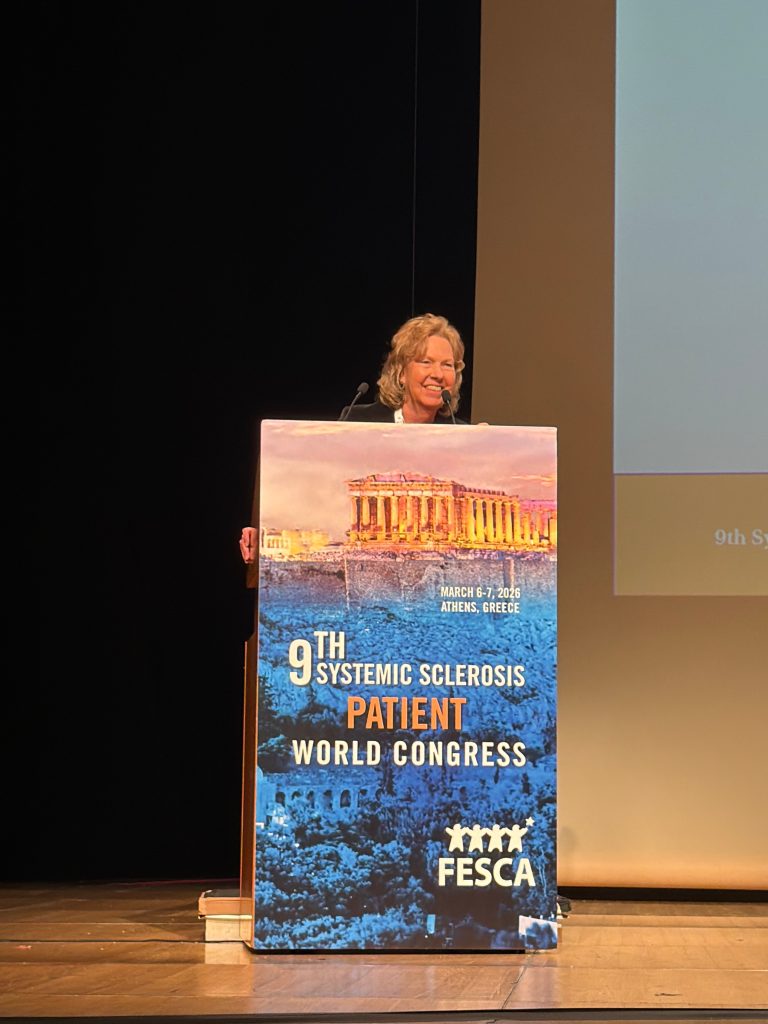
More than 1,000 clinicians and researchers joined together for the 9th Systemic Sclerosis World Congress. Organized by the World Scleroderma Foundation, the event runs parallel with the Systemic Sclerosis World Patient Congress. This year’s event highlighted how rapidly the research landscape in systemic sclerosis is evolving. Several key scientific themes emerged across presentations and discussions.
Earlier Diagnosis and Disease Prevention
One of the strongest themes was the push toward identifying systemic sclerosis earlier, before irreversible organ damage occurs. Researchers discussed advances in the VEDOSS (Very Early Diagnosis of Systemic Sclerosis) framework, which uses early clinical features such as Raynaud’s phenomenon, autoantibodies, and nailfold capillaroscopy findings to identify patients at risk of developing systemic disease. Studies are also exploring simplified capillaroscopy approaches that could make early screening more accessible in routine clinical practice.
Lung Disease Remains a Critical Focus
Systemic sclerosis–related interstitial lung disease (SSc-ILD) continues to be a major focus of research, reflecting its role as the leading cause of mortality in the disease. Several studies examined new ways to predict disease progression, including imaging-based models using high-resolution CT scans and emerging biomarkers linked to vascular injury and immune dysfunction.
Understanding Vascular Injury
Many presentations reinforced the importance of vascular damage as an early and central feature of systemic sclerosis. Research explored mechanisms of endothelial injury, new biomarkers of vascular dysfunction, and improved approaches for detecting complications such as pulmonary arterial hypertension and peripheral vascular disease.
New Therapeutic Frontiers
Some of the most exciting data focused on next-generation therapies for severe or treatment-resistant disease. Early clinical studies are evaluating innovative immune-targeted approaches, including CD19-directed CAR-T cell therapies, which aim to reset dysfunctional immune responses in systemic sclerosis. Other studies explored new strategies targeting B cells and immune pathways involved in fibrosis.
Regenerative Medicine and Tissue Repair
Researchers are also investigating regenerative approaches, including therapies based on adipose-derived stem cells and tissue repair strategies designed to address fibrosis and microvascular damage. These approaches aim not only to slow disease progression but potentially to restore damaged tissue.
The Role of Digital Innovation
Finally, the congress highlighted how artificial intelligence and digital tools may improve diagnosis and disease monitoring. For example, AI-assisted nailfold capillaroscopy systems are being developed to help clinicians identify scleroderma patterns more efficiently and expand access to specialized diagnostic techniques.
Taken together, these scientific developments point toward a future where earlier diagnosis, precision monitoring, and innovative therapies could significantly change the trajectory of systemic sclerosis care.
Cause for Hope
The progress presented at the congress shows how far the systemic sclerosis field has come.
But it also highlights an important truth: scientific innovation alone is not enough. To truly change outcomes for people living with rare diseases, research, clinical care, regulatory systems, and patient communities must move forward together.
When patients are partners in research, when clinical trials reflect real-world needs, and when scientific discoveries translate into accessible therapies, we create a system that works better for everyone.
The conversations in Athens made one thing clear: the future of systemic sclerosis care will be shaped not only by new therapies, but by collaboration across the entire community.
I am grateful to Sue Farrington, Ilaria Galetti, FESCA leadership and conference organizers for the invitation, as well as National Scleroderma Foundation leaders who participated (Zeba Hyder and Monica Ramirez) in this important Congress.