
In a recent interview, Kate Bogner shared her story with striking honesty and strength, offering a perspective shaped not just by survival, but by resilience and self-acceptance.
When she was just five years old, a small mark appeared at the top of her forehead. At first, it didn’t seem alarming, just a faint discoloration that puzzled her parents. Living in Montreal at the time, they turned to their pediatrician for answers.
But instead of clarity, they were told it was simply “a shadow” from the way her skull was forming. Her parents knew something wasn’t right.
“It was clearly not a shadow,” she recalled. “There was pigmentation forming, and there was an indentation.”
What followed were years of uncertainty. The mark slowly grew, but no one could explain why. It wasn’t until she was around 10 years old that a dermatologist finally recognized what others had missed: linear scleroderma, a rare autoimmune disease. The diagnosis brought a name – but not necessarily answers.
Growing up, she describes her childhood as active and joyful, filled with sports and time outdoors. Yet beneath that normalcy was a quiet undercurrent of concern. Her parents searched for information in a landscape where even medical professionals often lacked awareness.
That lack of recognition remains a problem today, and so does the sense of isolation many patients feel.

“The amount of people that message me and say, ‘Oh my God, I have never in my life seen someone else with linear scleroderma, I thought I was alone,’” she said.
“I still get messages on my Instagram almost daily,” she said. “People will say, ‘I have something that looks exactly like yours – what is it?’ They’ve gone to doctors, and no one can tell them.”
Despite the uncertainty, her condition eventually went into remission. Today, she has been free of active disease for more than 15 years. But remission didn’t mean the journey was over.
What remained was a visible scar across her forehead, a lasting reminder of the disease, and a new challenge she hadn’t anticipated. As she entered her teenage years, that visibility became difficult to navigate.
“High school was really hard,” she said. “I didn’t feel confident. I felt shame. I wouldn’t tell people what it was – I just said it was a birthmark.” While she now questions that instinct, at the time it felt necessary.
“Why do we carry shame around things we have absolutely zero control over?” she reflected.
The reactions from others only reinforced that feeling. There were whispers at school, stares in public, and questions from strangers that often felt intrusive.
“I’d be at the grocery store, just trying to buy something, and someone would ask, ‘What is that on your forehead?’” she said. “It was constant, and it still happens today.”
Over time, however, her perspective began to shift. What once felt like a source of insecurity became something else entirely.
“I’ve been able to pull myself out of that and feel grateful,” she said. “I made it through. I’m alive. It could have been worse.”
That shift, from survival to gratitude, marked a turning point. Today, she sees her experience not as something to hide, but as something that defines her strength.
“As I grew up, I realized it was my superpower,” she said. “It’s what made me who I am. It’s what allows me to inspire other people to step up and own what they think are imperfections.”
She challenges the very idea of imperfection itself.
“We’re conditioned to feel insecure about things society tells us are flaws,” she said. “But who decides what an imperfection really is?”
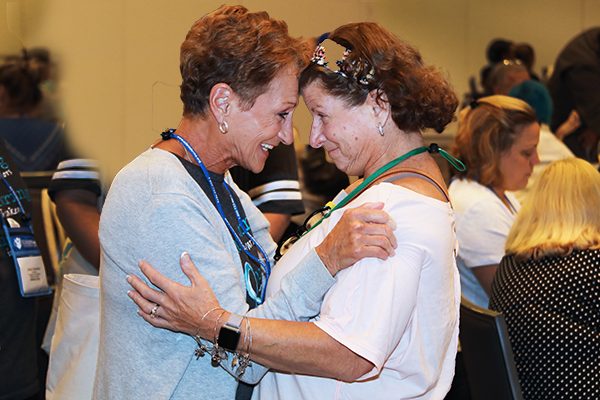
Her story is both deeply personal and rooted in the shared experience of the scleroderma community, one built on resilience, connection, and advocacy. Living with a rare disease often means facing uncertainty, but it also means finding strength in others who understand that journey firsthand.
Through her voice, she reminds us that no one should have to navigate scleroderma alone. Awareness matters. Representation matters. And perhaps most importantly, community matters, because together, patients, families, and advocates are redefining what it means to live fully, even in the face of the unknown.